
Open Houses: Recap of Session 1
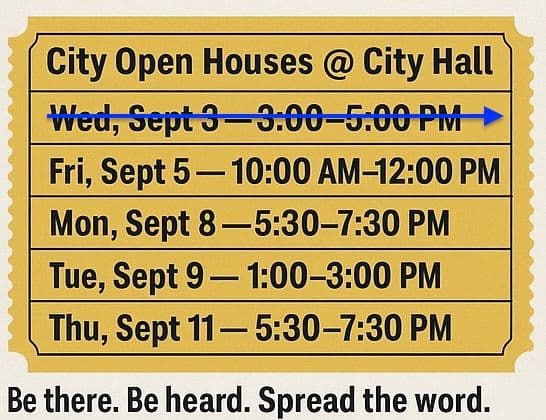
Next Open House is Friday, September 5th from 10 am to Noon
The Summary
The Planning Commission is making too many changes in one document. It is difficult for the community to comprehend the impact. This much change, done wrong, will divide the community. Or we could draw it together. We have a choice. The Planning Commission should table the Aug 18th changes for Planned Developments, Cluster Housing, ADUs by right, and Co-living from the draft. Address the smaller concerns about the draft zoning. Move the draft to approval. Address Planned Developments, etc, individually in future revisions only with community concurrence.
The draft is a dramatically different format and longer than the 2005 code, combining a mixture of 2005 and #439 rejected zoning proposals, with 9 months of step-wise discussion delving into the details. Everyone is well-meaning. But, there is a strong difference of opinion between preserve/protect on one side and develop/density on the other.
This is a draft. If you raise your voice, it will be heard.
Open Houses
The first open house was held on Wednesday. More than 50 citizens attended. Many new faces. The conversation with the Planning Commission was robust.
If you attended, we encourage you to attend again on Friday and bring your neighbors. If we want to end the remaining division, the community has to have a robust discussion with the Planning Commission.
Community Open Houses at City Hall
- Friday, September 5 - 10 a.m. - Noon
- Monday, September 8 - 5:30 - 7:30 p.m.
- Tuesday, September 9 - 1-3 p.m.
- Thursday, September 11 - 5:30 - 7:30 p.m.
- -
The Draft
The voters repealed the #439 Zoning, favoring the 2005 edition. No one formally asked for another draft. In the winter listening sessions, citizens were asked what they wanted in new zoning. For the most part, they said, “Zoning that is easier to read.” We suggested recasting 2005 into the new format, finishing in early May. Updating incrementally from there. The Planning Commission instead resumed the monumental task of revising the entire zoning regulations early in 2025.
While modern planning trends often advocate for affordable housing, accessory dwelling units, and mixed-use development, these ideas are not universally appropriate. Harbor Springs must prioritize its community’s voice, which clearly supports preserving single-family housing and maintaining the community's historic character.
We don’t recall a huge outcry for density, development, cluster housing, tall buildings, etc. It appears that everyone would like to find a way to make housing easier for the workforce. If someone has a plan for the workforce, they need to present it.
You really need to look at the new code to understand how hard this process is. It is more than 150 pages. There are multiple drafts. It is very easy to get confused. The response to confusion is not Fact Checks and accusations of “Misinformation”. The proper response is a discussion.
A view of the Wednesday Open House
The first open house took place on Wednesday, September 4th. Citizens raised 30-40 substantive points during the Open House. The main concerns centered around Planned Developments, Cluster Housing, ADUs “by right”, and Co-Living.
Our sense is that the City wants to approve the draft and delay addressing community concerns until later, perhaps with a revision. If true, it is a bad idea. We do not accept mediocrity.
Things got heated in the August 18th Planning Commission meeting when the procedural language for Planned Development was applied to Districts. That moved the Planned Development conversation from an abstract point of procedure in a draft to a realization that we could have hotels on the waterfront.
If speed of approval is important, then retain the 2005 principles and defer the proposed changes in Cluster Housing, Planned Developments, ADUs “by right”, and Co-Living for now. Given these are so intertwined with density, workforce housing, full-time resident affordability, etc, don’t muck up the discussion in a rush to finish the bureaucratic task of the draft.
Some Important Points on Planned Developments
The current Planned Development language in the 2005 code has very stringent rules on height, acreage, and other objective criteria.
The Planning Commission chair argued on Wednesday that the new criteria, which eliminate height, minimum acres, etc, are equal in their strength. Read the draft for more details, but here are the rough terms:
The PD must meet, as a minimum, five (5) of the following seven (7) objectives of the City.
- -
Since the Planning Commission chair and we are not experts on this topic, we discussed this with a lawyer who has litigated both sides of these issues, as well as two consultants with 30+ years of experience advising towns like Harbor Springs. Here are their thoughts:
- The 2025 draft creates subjectivity in decision-making. This creates multiple approaches for litigation. Height and acres are measurable; “Desirable and in the public interest” is not. The new zoning gives a developer unique power to threaten the City with litigation and extract a compromise in favor of the developer.
- The draft appears to remove the right of citizens to appeal to the ZBA for Planned Developments, giving an advantage to developers.
- Communities like Harbor Springs have recently altered zoning to allow ADUs and STRs. There are lessons to be learned. If we move forward with the proposed code, and address issues later with these uses, we risk having to issue permits and allow new construction, which could become future “legal non-conforming uses or buildings”, the exact things the City is trying to overcome with other proposed changes to dimensional requirements in the various residential and commercial districts. At a minimum, the lessons learned from other Michigan resort towns should be reviewed with the community and discussed.
- To promote housing, ADUs should be banned from being STRs. Property should only allow one rental permit per lot, to avoid the main house and ADU being leased to different people.
- Rental units need strict and enforceable occupancy rules to prevent out-of-control property use.
- If the zoning opens up property rights, it is very difficult to take them away in the future if ADUs, Cluster Housing, PDs, or Co-Living get out of control.
- Past community surveys support maintaining the community character and preserving single-family housing. Don’t diverge from community interest in favor of guidance from administrative staff.
- When you make a zoning change, you need to anticipate and address unexpected behavior that is counter to the intended outcome. The City, for example, does not require a large lot size in the Zoning Code, but most new homes are being built on multiple lots to accommodate the desired home. Greater density and smaller homes are not going to solve the housing concerns in Emmet County, only raise the value of small homes in Harbor Springs, as market demand is high in this desirable resort community.
While the Planning Commission may wish to conclude the zoning update process, these changes impact each homeowner in unique ways. The Planning Commission initiated these proposed changes and a major rewrite. To finish the Job, they need to convince the property owners and citizens to replace the 2005 code with the 2025 draft.
Given that many changes discussed earlier in the year are acceptable, and there is serious debate on ADUs, Planned Developments, Cluster Housing, and Co-Living, if speed is important, simply exclude these changes from the draft and move forward with addressing the other input from the Open Houses.